| |
|
|
 |
|
 |
|
 |
| |
|
Trout in the Classroom |
| A Partnership for the Environment |
| |
This hands-on, flexible program has
won national acclaim and is in place in classrooms internationally.
Raising trout in the classroom connects students to water quality
and other real-life issues and inspires them to seek solutions to
problems. The program is simple: teachers set up an aquarium and
incubate trout eggs in their classroom under the guidance of a Trout
in the Classroom (TIC) coordinator. Students watch as trout develop
from eggs to fry, with the final result being a field trip to
release the young fish into the wild. This up-close-and-personal
involvement develops students' interest in the
environment necessary for juvenile fish to develop into healthy adults. These
interests inspire questions about the needs of humans and their
relationship to the environment.
The program encompasses not only science
but language arts, mathematics, social studies, ecology and art. |
| |
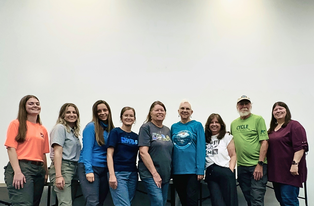
The
Dan River Basin Association and Trout in the
Classroom (TIC) formed an exciting
partnership to promote shared goals of
stewardship and education for students in
Henry County, Patrick County, and the city
of Martinsville, all in the Virginia portion
of the watershed. Dr. David Jones, a
Martinsville orthodontist, supplied 19
aquariums, support materials, equipment, and
brown trout fry to area schools and the
Virginia Museum of Natural History.
For over three months, students and teachers
collected data, regulated feedings,
monitored water quality and successfully
raised the trout to fingerling size.
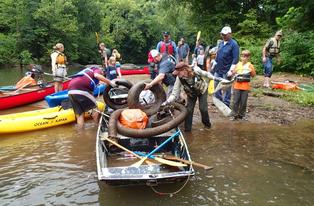
Events were later held to release the trout
into the Smith River. |
|
Top of Page |
|
Linking Lessons
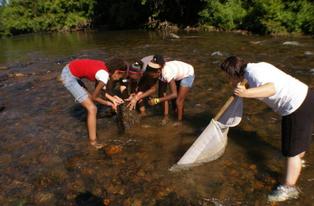
DRBA’s efforts of
stream water quality monitoring using the VASOS protocol of
determining the density and diversity of a streams’
macroinvertebrate population (the main diet of trout) was a natural
companion to the TIC project. Linking the two concepts, through
both classroom and streamside demonstrations, gave the students a
broader perspective of the impact this project would be making on
the environment.
The DRBA
presentation illustrated the water cycle, rural versus urban effects
on a stream of storm water runoff, types of pollution, the
importance of preventing pollution, hands on identification of
macroinvertebrates, and a mini ecosystem of macroinvertebrates.
Restoring the
Fisheries
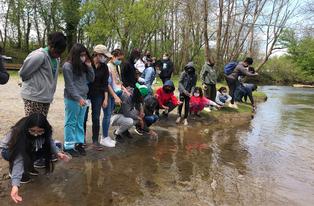
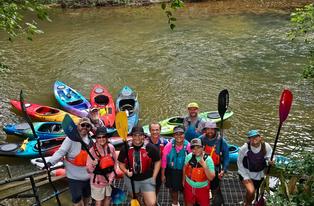
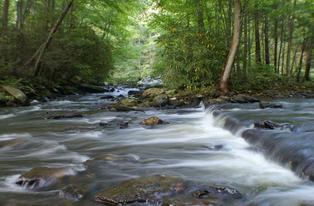
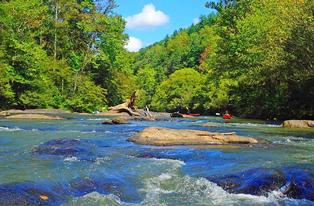
The Smith River
provided a beautiful panorama as the students and teachers bid
goodbye to their trout during a series of releases. While 2000 or
more students participated in the school wide program and were
responsible for the care of the trout, 1500 participated in the
release of over 2000 trout into the Smith River during 16 separate
events. The DRBA program was presented at these streamside releases
as well as at six additional classroom sessions. |
| |
| Improving
Academic Performance |
|
The teachers found
creative ways to relate the young trout and their health to science,
math, art, history, government, and writing. The enthusiasm
generated by this hands-on project has been unprecedented, the
teachers say, in producing students who want to come to school to
learn. School administrators have been so impressed with the
overall positive effect on classroom participation that some are
planning to implement curriculum changes to parallel the TIC and DRBA project. |
|
Top of Page |
| Widespread
Positive Results |
|
DRBA and TIC look
forward to the next school year when the students will have the
opportunity to begin the program at the egg stage. The impact of
this project for the local environment, the brown trout fishery of
the Smith River, the local economy, and the broadened education
perspective of our students cannot be overstated. The initiation of
this project, its financial support, and the dedication to its
successful conclusion belong solely to Dr. David Jones. DRBA is
proud to collaborate with and participate in such a valuable
effort. |
| |
|
Parts of this article
and all photos were submitted by Wayne Kirkpatrick.
Permission given
for reprinting in whole in the Dan River Basin Association
Newsletter and the Virginia Sporstman Magazine and on the
Dan River Basin Website |
| |
|
BACK
|
| |
|
|
|